Showing posts with label small things. Show all posts

Thursday, February 28, 2013

Peripheries

or Coming to Terms (Again)

If you go back to its roots, a periphery is literally something that is "carried around."  Back in the 16th century (or the 14th, depending on your source), the word referred to the atmosphere around the earth.  I'd love to know what, in those long-ago days, people really meant by atmosphere.  Maybe they had something like the Belt of Venus in mind:  the pink glow carried around the horizon at dusk and dawn, at the point where light and dark merge—something visible and radiant with the vast unknown beyond it.

"Periphery" has long since lost that atmospheric shade of meaning, and even its literal one.  These days its primary definition is simpler:  the outer limit or margin of something.  It's a neutral word, describing plain facts.  Take the fine hairs on Sempervivum leaves, for example.  They grow on the leaves' peripheries, on their margins or outer edges.  That is a simple truth, and periphery sums up those little hairs' place in the world without question.

Something beautiful gets lost in the summation, though.  Even in the softness of shade, those delicate whiskers carry light around the periphery of the leaves and bring an atmosphere shining to life.  The edges are where light gathers and plays.  The periphery isn't a neutral place—it's where the magic happens.


Still, better a neutral meaning than a negative one.  The other definitions of periphery aren't so pleasant.  They're about relative position and status:  inside vs. outside; center vs. edge.  To be on the periphery is to be marginal, secondary, in a lesser or unimportant position.  It's to be like the second of the hens-and-chicks in the photo above—on the edge of your awareness, fuzzed out of focus.  Not central to anything, even though you might notice if it weren't there.  Just...not mattering all that much.

Is anything as fascinating as the periphery of a tulip leaf?  At least, until the tulips bloom.  Then the leaves become...peripheral.

I've been a little thoughtful about peripheries lately, a little pensive.  I've missed some activities that kind of broke my heart not to be a part of—an impromptu cello performance by my oldest nephew, some dear friends' son's bar mitzvah—because, even though I'm doing better than I have in years, I'm not well enough to participate fully.  CFIDS/ME really puts you on the periphery of your own life, because being in the thick of things is too disabling.  You make it work for you:  you find other avenues for life, like blogging and Facebook, and reveling in the small wonders in a small garden.  Over time, you kind of forget what "normal" life is like.  But then you have a sudden reminder of the everyday pleasures other people enjoy unthinkingly and realize how far out on the periphery you are.  You are a bit like Gomer Goldfish:

Except that I'm never that grumpy.  Obviously.

This really isn't a down-hearted or complaining post:  I know full well that being peripheral to activities does not make me peripheral in the hearts of those who love me.  There are so many things that I can do.  The things I miss out on do not diminish the value (or my enjoyment) of the "less important" things that come my way.  And I really like my sofa; you could not find a more comfortable sofa to lie on.  For hours on end. 

It is, however, a thoughtful post.  I've found myself wandering around the garden (in a non-strenuous way) looking at leaf edges, at boundaries and margins and outer limits, and wondering about them.  What does it mean to be on the periphery?  And if it means something unpleasant, what can I do to change it?  I can't change illness (so far).  It has set the limits.  So instead, what can I do to change the periphery?  To make it, not a place that's out of focus or on the edge of awareness, or even a place of neutral fact, but a place where light gathers and plays, a place that carries its own radiance around with it and has, maybe, just a bit of a pink glow?* 

On the periphery between shade and sun.

How can the periphery be a place where magic happens?

_________________
* Except that I'm not really all that fond of pink.

Thursday, October 18, 2012

"The Clock Stopped Long Ago"

or Sandia Park, New Mexico


The sandstone glowed in late afternoon sun.  A raven called as it passed overhead, a deep, throaty croak that rang briefly before melting away.  Its wings beat with audible effort—not the quick flutter of the Oregon juncos and scrub jays darting between junipers, but a good, sturdy flap as it pulled against the air.  That, too, melted into nothing.

The afternoon leaned against a vast backdrop of silence.  Small sounds leapt out, like grasshoppers from a meadow, without disturbing the silence at all.


Away from Albuquerque's urban junkyard of a soundscape, on still days in the piñon and juniper deserts of the lower Sandias, white noise disappears.  Not just from cars and airplanes and swamp coolers and power tools, but from nature, too.  No constant, companionable sounds fill the space around you:  no mountain brooks gurgling and splashing, no clattering leaves in aspen trees or big-tooth maples, no grasses thick enough to rustle.  Silence surrounds you like sandstone, shaped only by the sweeping wind.  The coyotes, howling at sunset or in the chill dark before dawn, make little pinpricks of sound, like stars glimmering one at a time in the enormity of space.

Doesn't the rock look like a coyote?

I found myself pondering the middle layer of experience between the very small and the very large—the shady-tree-and-gurgling-brook level of experience—during a few days' stay at a casita in Sandia Park last week.  Ansel Adams said of New Mexico,
"It is all very beautiful and magical here, a quality which cannot be described.  You have to live it and breathe it, let the sun bake you into it.  The skies and the land are so enormous, and the details so precise and exquisite that wherever you go you are isolated in the world between the micro and the macro, where everything segues under you and over you and the clock stopped long ago."*
The micro and the macro.

Sandstone

The view from that particular bit of sandstone

To say that New Mexico is a place of extremes is certainly true, but maybe not quite enough.  It's more that the stuff that ordinarily lies between extremes, the broad stretch of middle ground where humans tend to look for ease and comfort, is absent.  I can think of many places of spectacular grandeur—the Colorado Rockies, the Grand Tetons, Idaho's Sawtooth Mountains—where you are dwarfed and awed by the magnificence around you.  You have companions in dwarfishness, though.  The forest trees may tower over you, the lakes may be deep and cold, the elk may bugle hauntingly out of a chilly late-summer night; but they are all still somehow on a human scale, comprehensible, embraceable.

Here, though, you feel like the odd one out.  You may be dwarfed by the whole of the landscape, but you are taller than most of the things that grow on it—when anything grows on it at all.


You are like Alice in Wonderland, if she'd been caught between the Eat Me and Drink Me phases, a little too large, or much too small for your surroundings.  You're isolated between the enormous


and the exquisite,


 in awe of both, but not belonging to either.  You feel vulnerable


in an exhilarating way,


and after a long, glorious day of vulnerable exhilaration you are grateful to the junipers, with their soft, shaggy bark,


and to the piñons, with their fair to middling size, for bringing things back (somewhat) to scale.


You know it isn't really a timeless place.  The clock keeps ticking; the modern world does intrude.

Poised as you are, though, between pointillistic details


and wide expanses,

in that deep quiet, you find balance, and a peace that does seem timeless.


And you wish with all your heart, that for a few more days, time really could just stand still.

__________________
*Quoted in New Mexico. A Guide for the Eyes, by Elisa Parhad.

Sunday, April 1, 2012

Ephemeral

or A Moment of 'Meh'

A fever that lasts for a day—that's what ephemeral used to mean.  In the 14th century it was a medical term to describe illnesses of short duration.  Only later, over the course of several hundred years, did the meaning of something gone in a flash extend to flowers and insects and experiences.  (I do like a word with a past.)

When we talk about "spring ephemerals" I wonder idly sometimes whether we're really referring to the season's colorful, short-lived flowers, or whether we're back to human fevers that last for a day.  Such heady, dizzy excitement for this flash-in-the-pan experience—like gold fever, only without the prospectors and picks and mules and claim-jumpers and boom towns.  (But other than that, just the same.)  We work ourselves up to fever pitch when those first leaves appear and savor every minute of growth and bud and bloom.  We know that a few too many weeks of yellowing leaves will follow, but they will have been worth it for the short-lived, intense enjoyment of those flowers.  What we don't want is to work ourselves into a state of hopeful excitement for something that turns out to be—

But let's start with the enjoyment.  Take the Lady Jane tulips (again).  (Apparently, they are not really Tulipa clusiana, in case that matters.*)  As buds and half-open flowers, they exude delicious elegance.


When they open fully, though, their secret life as wildflowers is divulged, and they have a kind of carefree rough-and-tumble to them that I love.


The weeks of anticipation are worth the few days of pleasure—Lady Janes are beautiful for every minute until they pass their prime.

The 'Persian Pearls' (T. humilis) only last for four or five days and then efface themselves quickly, leaves and all.  If none of their blooming days falls on a weekend, I don't get to see them open in the sunshine, but never mind.  Just knowing that they can outshine stained glass and that I might see them doing so makes up for a disappointing year now and then.  You live them up when you can.


But now we come to the Tulipa tardas.  I had such high hopes for these small flowers (they only get two to four inches high).  The buds were promising, with a complex array of glowing colors.


But then the flowers turned out to be a bit of a mess.


Granted, they are luminous in the sun, and anyone lying flat on the concrete patio can certainly enjoy that effect to the full.


When they open—at high noon, for half an hour or so— (what more do they want than a full morning of high desert sunshine?), they're mighty cheerful, as you can tell if you're standing directly over them and looking straight down. 


From the Adirondack chair on the patio, though, you mostly just see mess.  I feel a bit disillusioned.  Spring flowers are not supposed to leave you with a feeling of...well, for lack of a better word, meh.

I don't usually adopt the latest words of the moment.  Not out of principle or anything; they're just ephemeral enough that by the time I figure out what they mean they've begun to fade from popularity anyway.  But a flash (in the pan) of insight today suggested that "meh" was just made for unimpressive tulips.  Both of them are here and then gone, without anyone getting too worked up either way.  I can handle that tepid, evanescent nothingness in a word—not all words can have the longevity of "ephemeral," after all.

But I don't see the point of it in a tulip.

________________________
* The long stems of Darwin and other hybrid tulips often break in the spring winds around here, so regional growers recommend wildflower or species tulips instead.   (For what it's worth.)

Thursday, February 23, 2012

Nestling

or Wild

Artsy-craftsy little towns seem to breed in the Finger Lakes area of New York.  Walk into a shop along any Main Street, and you'll find yourself up to the eyebrows in artisan-made glass paper-weights and figurines, pottery mugs with iridescent glazes, hand-dyed silk scarves, and warmly glowing, inlaid woods.  In those stores you move slowly and keep your hand-bag close, lest you knock something breakable to the floor.

I lived in one of those little towns during my mid-20's.  Sometimes after a stressful day I would make a beeline for its row of boutiques, that hushed world where slowness and gentleness reigned, and beautiful things murmured from every shelf and corner.  I would pick up a delicate objet d'art and hold it nestled in the palm of my hand as if it were a wild bird until the stress subsided.

I'm not sure why it worked.  Perhaps it called up deep memories of wonder, of being six and standing rigid and breathless with awe as a ladybug or inchworm or roly poly tickled its way across my palm.  Or maybe the hush reminded me of childhood excursions in the mountains, and Dad whispering "Don't move" in my ear, his hand on my shoulder to still me, while a mule deer crossed the path in front of us.  For whatever reason, in treating things gingerly and holding still, my more grown-up self would remember that hush of wonder for a moment.  I'd walk back out of the store comforted to know that not all problems have to be conquered—some of them really can be tamed instead.


I've never been a huge fan of gravel mulch, which is a pity out here in The Land of Gravel Mulch.  It is an improvement over thirsty lawns and mowing, but still—in most situations gravel is hot and harsh and full of edges in a climate that can be all of those things on its own, without any help from the peanut gallery.  Plants don't care about my preferences, though.  Most of the things that thrive here prefer poor, rocky soils.  I've ended up mulching a couple of the beds in the garden with various sizes of flat, rounded river pebbles, the kind I dig out of the garden anyway.  In late winter, when I've trimmed back the autumn sage and gaura so that the crocuses beneath them can get some sunlight, the long bed beside the patio is very gravelly indeed, in the southwest's characteristic "dry riverbed" sort of way. 


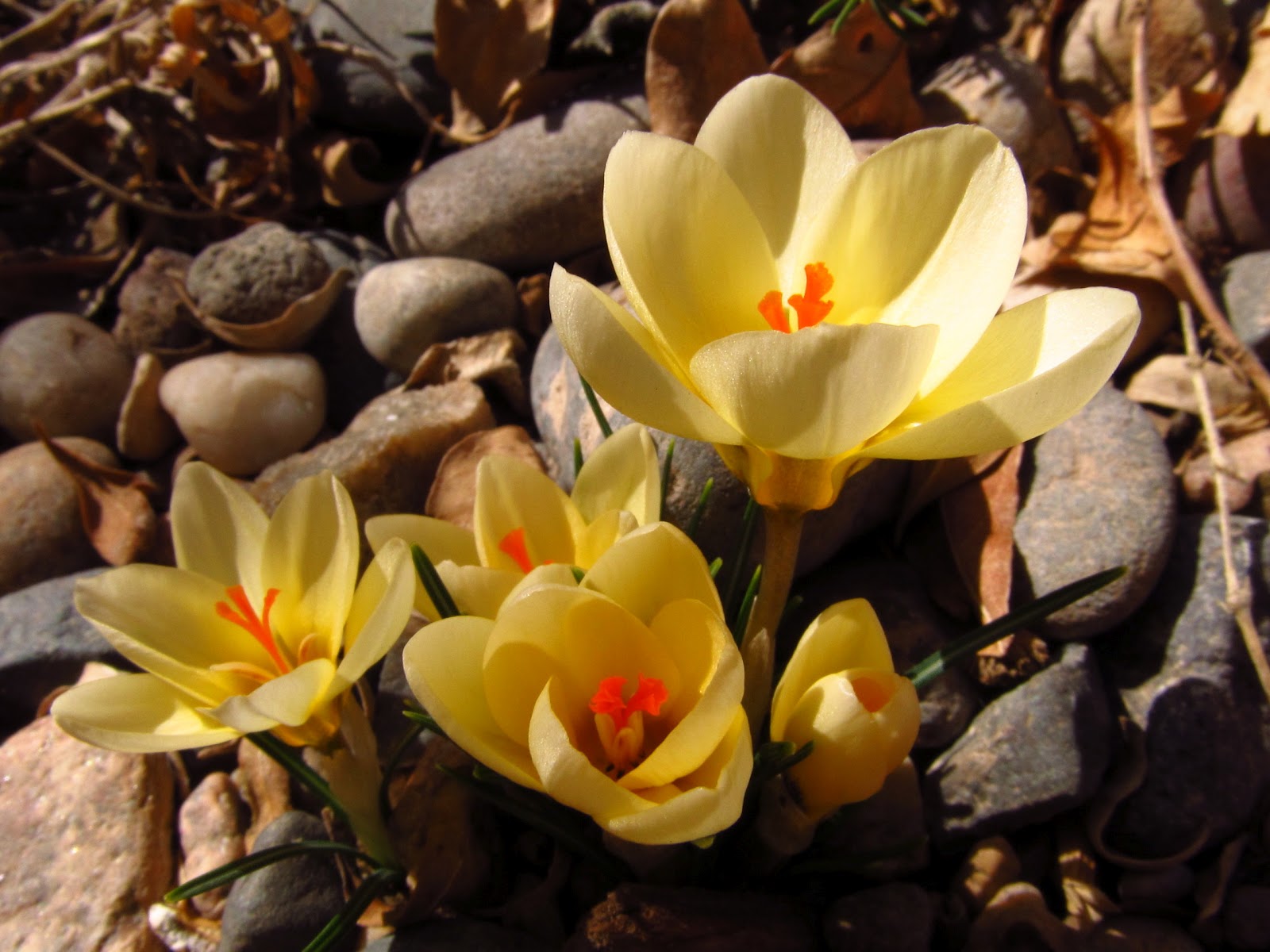
I dream of (and plant) swaths of crocuses in all the beds but get little dots of them instead.  From a distance the individual flowers are kind of disappointing (though up close they're as lovely as anyone could wish).  In the gravel beds, however, I've begun to find those dots of bloom enchanting.  They've nestled in among the larger pebbles, where they look fragile and shy and wild, as if they've blown in on the wind and are taking shelter.  Their translucent petals remind me of moth wings, and I almost expect them to flutter off if I startle them. They're so very ephemeral, especially next to the solidity of stone.  I find myself moving slowly, gently around them, as if they were birds to be coaxed to the palm of my hand, and touching them with feathery light fingers.

The crocuses are no more wild than the artisan-made figurines I used to cherish against inner storms.  But they, too, make me think of that sudden hush when something wild and beautiful crosses your path, of the child's wide-eyed wonder when some small, six-legged creature makes its way across the landscape of your hand.  Suddenly I'm less interested in conquering the garden beds to impose my vision of glorious drifts of color, and more content to have my desires tamed by those little dots of bloom. 


Perhaps I've been tamed and conquered both...

_________________________

I'm continuing with the Thirteen (or Fewer) Ways of Looking at a Crocus (or Some Equivalent) Challenge I set myself a couple of posts ago.  Some of my favorite bloggers have responded to the invitation, too.  Please pop over to Experiments with Plants, where b-a-g revels in the color saffron and posts a tasty-looking recipe to boot.  And HolleyGarden at Roses and Other Gardening Joys writes beautifully about small things in A Bloom of Significance.

Thursday, December 15, 2011

Much Ado about Nothings

or The Power of Fluff


Such a tiny feather, just a 3/4" bit of down that was as white and billowy as a fair-weather cloud.  It came to roost among the thyme-leaf speedwell early last month and stayed for several days.  Next to its airy softness, the speedwell leaves looked thick and heavy; not for them the joy of floating effortlessly on a breeze.  The feather rippled in winds so slight that they were imperceptible to me, dressed against a November morning.  Even when I set my hand right next to it, I wasn't sure whether I was feeling a breath of wind or of imagination.  But then, down is especially good at trapping air, at holding it close against a beating heart, a small body of hollow bones and flight feathers and hunger, where it can warm and insulate.  It is a cushion against the jagged edges of frost.

Butterfly milkweed (Asclepias tuberosa)

Late in November the lone seedpod on the milkweed finally burst.  I have never yet been able to resist the feel of the seeds' downy floss, and its touch sent me instantly back to childhood:  pressing my thumb along the inside seam of a seedpod to break it open, easing apart the featherbed inside and teasing out the individual seeds, then sending them flying, one by one, on a breath.  Those days, I wasn't particularly interested in the seeds, only in the parachutes that held them so magically aloft in ways that the swingsets at school just couldn't manage. I didn't give a thought to the responsibility those bits of fluff carried with them, to keep their own lifeline going.  But they did teach me the joy of occasionally casting your fate to the winds.

Thyme-leaf speedwell (Veronica oltensis)

The speedwell didn't mind the frost the other morning any more than it had minded the feather.  Just to give you a sense of scale, its leaves are only about 1/8 inch across.  The ice crystals on them are tiny, indeed.  Some had been just pinpoints of water vapor before alighting on the colder surfaces of the leaves, where they condensed and froze.  It's hard to believe such delicate particles had the power at their backs to fell the milkweed overnight, to cast it into a deep sleep as surely as a bite from a magic apple.  


Even mid-December has days of fair-weather clouds—"decorative clouds", as one of my favorite weather forecasters calls them.  You don't expect any moisture from them, and they don't really get in the way of the sunshine.  They just cast softly shifting patterns across the sky that mesmerize you with their fluidity.  They float along in such an easy way, like milkweed seeds held aloft and slowly spinning, drifting on the wind.   That effortless buoyancy, though, belies their enormity.  They carry 350,000,000,000 water droplets per cubic foot (according to the The Cloudspotter's Guide).  "Modest-sized clouds" weigh as much as a 747 or possibly 6,268.75 blue whales—about as many as you can shake a fish at in a day.  Even smallish clouds stretch to a kilometer in diameter.

And from here they look as light and insubstantial as a bit of down.

Thursday, December 1, 2011

Hope Springs Eternal

or The Little Potato That Could Couldn't Hasn't So Far

Sometimes potatoes just go overboard with optimism.  Take this one, for example:

Nov. 24, 2011

I planted it five years ago, in the bed that now holds the Sad Sand Cherry but at the time was home to a Truly Miserable Golden Currant (Ribes aureum x Tristissimus).  The idea—brilliant, so far as it went—was to grow the potatoes just inside what would become the currant's drip line once it matured.  In the meantime the spuds would fill a large space in the infant garden with swaths of greenery, practically for free.  Since I would be giving the new plantings extra water anyway, the potatoes would get all they needed to flourish.  Gently unearthing the tubers with a small garden fork at season's end would loosen the compacted soil again, and the currant's roots would have an easy time spreading into that area their second year.  And then there would be potatoes to eat. 

The delicate bubble of genius, alas, was no match for the freshly sharpened tungsten carbide circular sawblade of reality.  The potato leafhoppers moved in for the kill, drat them, and none of the potatoes survived for more than a month or two.  That fall I planted other things in their place and then forgot about the potatoes altogether.  Great was my surprise the following spring, when one little spud sent up a hopeful shoot amid the tulips and yarrow.  It grew in a small (3- or 4-inch) way until June, when the heat and aridity (and leafhoppers) proved too much for it.  Then it withered sadly away, to hoard its resources for the following spring.

Every year since then, it has done the same thing.  I have begun to look forward to seeing the potato raise its little hand every spring, in the way that normal other people look forward to the first lily or allium leaves.  I cheer it on but don't give it any extra water, which by now its xeric neighbors would resent.  The leaves always die away again in a few weeks.

Lately the tenacious tuber has changed tactics.  If summer is too hot and dry, it seems to be thinking, then why not come up in the fall?  A few weeks ago, in a bed that by now is in deep shade, this frost-sensitive, sun-loving plant began sending up a hopeful shoot.  I showed it the calendar, with the average first frost date marked in red; I showed it the blackened basil and marigold leaves in the garden's less protected places, to no avail.  Sometimes a potato just will not recognize the difference between hope and denial.  It will not be discouraged.

Nov. 29, 2011

At least, not until it's too late.

Thursday, November 24, 2011

Rain in the Desert

or A Time for Thanksgiving

We haven't had much rain recently, at least not enough to measure.  A tease of a storm blew through town on Monday that left a trail of perfume and a lot of flustered leaves in its wake.  It flung a lacy, mocking shawl of snow across the Sandias' rugged shoulders and then swirled away into the night, ignoring the rain gauge altogether.  Albuquerque has only had 3.48 inches of moisture this year, so even a tease is...maybe not welcome, exactly, but better than nothing. 

Learning to be grateful for every drop of rain also reminds you to see cause for rejoicing in every simple gift and every good thing.  That seems like an especially fine thing to remember today.  To those of you who join me in celebrating Thanksgiving, best wishes for a wonderful holiday, with all the warmth and joy the day calls for!  To those of you around the globe, I hope you won't turn down a glass, cheerfully raised in your honor.


And by all means, please join me in another, in honor of small blessings.


________________________
(The "word art" was prompted by Noel Kingsbury's recent post at Gardening Gone Wild, which featured some of Alec Finlay's work.)


Thursday, November 10, 2011

Cussedness

or In Which We Celebrate Individuality, Whether We Want To or Not

The furnace really was more important than the Western sand cherry bush (Prunus besseyii).  I thought so last February when the temperature dropped to -7°F (a 40-year low) and the furnace broke down, and still think so now.  The repairman did a wonderful, careful job despite vicious wind and sub-zero temperatures and was cheerful the whole time.  Even so, the part of me that likes to ponder the general cussedness of things wondered what law of nature decrees that with three feet of clear space and a brick path to stand on, a workman must nevertheless step on the plants.  The Sad Sand Cherry, poor thing, was apparently in the way, and after its little adventure with big boots, it took a while to recover.  Three seasons later it's still missing half the branches on one side and looks pretty lopsided.  It didn't grow much over the summer, but it lived, and that's saying something, in an Eeyore-ish sort of way.  Now, autumn has come to it in spots.


Autumn or chicken pox?  It can be so hard to tell.

Meanwhile, across the path closer to the patio is another cherry planted at the same time two years ago.  It gets quite a bit of shade from one of the desert olives (Forestiera neomexicana) and isn't growing quickly, but it's thickly leaved and branched and looks strong and healthy.  It is now officially taller than the salad burnet, and it produced one (1) cherry this year.  I was so proud.  The Slow Sand Cherry is fixin' to enjoy some autumn, but maybe not all at once.  It's getting there, though, one easy-going, leisurely leaf at a time.


The other cherry near the patio is what I expected all of them to be—about three and a half feet tall and wide, more or less nicely shaped, thickly leaved, full of cherries, and generally well-behaved.  It's been in the ground for four years and has officially graduated to drought tolerance.  (Now there I am proud.)  The Teacher's Pet Sand Cherry is still mostly green, but it's beginning to change colors ever so delicately and attractively.  With impeccable timing, it should be at its reddest precisely when its neighboring olive tree is at its most golden-green.*


And then there's the Big Hairy Monster in the far corner.  I love that cherry.  It's about six feet tall and wide, way too large to be convenient, half again the size I thought it would be.  I end up whacking it back hard twice a year, and it still blocks the path.  But boy, is it gorgeous.  If I remember correctly, it was one of the first things I planted in the garden, if not the first.  Back then I nurtured things properly, rather than just plopping them in the ground and wishing them luck.  I watered regularly and fertilized carefully and worried and fussed, and as a reward I have a healthy, happy monster on my hands that's really way too big.  Two weeks ago it looked like this:


But now it looks like this:


For the record—because you certainly can't tell from looking—the point of planting four bushes all alike in the four quadrants of the garden was to enjoy a little symmetry.  Not uptight symmetry, not super-pruned rigid sameness or anything, just a general sense of kinship between one part of the garden and another.  The idea was to create a single, overall effect, especially in the fall, when I had hoped for a garden full of rust-red leaves.  All at once.  That is to say, all at the same time.

I don't really expect the two youngest bushes to be the same size yet as the older ones.  I understand that the Sad Sand Cherry has had a hard time.  And boy howdy—micro-climates, are they everywhere or what?  Not one of the bushes has the same growing conditions as the others, even though they're only a few feet apart.  Genes can sure be different from one plant to the next; colors do vary from year to year.  As personal problems go, having your shrubbery out of sync ranks so low that it doesn't even make the list.  And yet— 


I'm just going to mutter "Vive la différence" for a while until I believe it.

__________________________
* As a fine example of cussedness, this exemplary sand cherry is the one of which I am least fond, for no apparent reason.

Thursday, October 27, 2011

Pre-Emptive Strikes

or A Little Help Goes a Long Way

As inspirational garden photos go, this one ranks pretty far down the list:

Exhibit A

It won't be gracing the cover of National Geographic any time soon.  The sky is nice and blue, sure, but you can look outside and see blue sky any day of the week.  Day in, day out, from one horizon to the other, nothing but blue, blue, blue.  Hardly worth wasting pixels on.*

And OK, the trees are losing some leaves up there at the top.  October is galloping toward the finish line, and many of us in the northern hemisphere do expect our deciduous trees to lose a leaf or two in October (although these particular trees generally wait until November).  Then again, we also expect them to be picturesque, not all scraggly and haphazard.  But this isn't seasonal leaf loss, not the disheveled loveliness of autumn, nothing that would make you want to go for a tramp in golden woods, kicking up fallen leaves as you go.

Sadly, this is just what the top branches of all three desert olives (Forestiera neomexicana) look like from mid-August on, until some windstorm in November mercifully tidies the rest of the leaves away.  The bareness can't even be blamed on the leaf rollers that plague these trees every year (just mine for some reason; the rest in the neighborhood—and apparently the entire southwest—are fine).  The culprits are actually some of my otherwise favorite garden visitors, ones I go out of my way to court:  the cheerful, gregarious, brightly-colored, overly communicative, endlessly hungry lesser goldfinches.


"Who, me?"

One goldfinch in spring is a mighty fine thing; a mated pair quite exciting.  Two pairs make your heart go pitter-pat with hope and delight.  When both pairs clutch in late summer, you're thrilled at the wonders of nature.  You enjoy seeing the couples become families, and you laugh sympathetically at the fledglings' accidental antics.  Then the pairs produce a second clutch apiece, and before you know it, two dozen lesser goldfinches are perched in your desert olives, impatiently waiting their turn at the feeder.

Except "perched" isn't quite it, is it.  They're clinging to the vertical upper branches, and sometimes their unpracticed feet slip a little, taking a leaf or a bud with them as they slide down.  One leaf here, another bud there, and pretty soon, what with gravity taking its toll and all, those upper branches have no leaves left.  Since the finches have done the same for several years running, long, bare gaps show on older branches, too, where the buds were sheared off by little bird claws, back when those branches had their turn being the slender ones at the top.

Exhibit B

Don't get me wrong:  I love the lesser goldfinches.  They are not only enjoyable but useful, and I'm quite grateful to have them around.  They're not strict vegetarians like the American goldfinch, and they have dined on many a pest (we'll assume that they were pests—why would a goldfinch eat beneficial insects?) in the trees when the feeder was occupied.  They've even helped keep the leaf rollers under control, and in the most ingenious way.  Not content with just eating the little caterpillars, the finches have gone one step better, making sure that there are no leaves for the rollers to eat.

Is that brilliant or what?  Talk about thinking ahead.  It's almost as clever as taking the gas tank out of your car to make it more fuel-efficient, or turning chickens (gently) upside down so they lay their eggs over-easy.

Almost as clever, and even more effective—and yet, somehow, maybe missing the point?
________________________
*Disclaimer:  I wrote this last week, in the middle of a long spell of sunny weather.  We've seen a cloud or two since then.

Thursday, September 8, 2011

True Blue

or Reality Check

The dwarf plumbago (Ceratostigma plumbaginoides) isn't really this color:


It should be more purplish, less of a sky blue.  My camera seems to prefer this color, though, no matter how I fiddle with the white balance, and I like it fine myself; it just isn't true to life.

The sky isn't actually this vivid a blue, either:


If you don't want to over-expose a sunlit building, however, you have to shut some light out of the photo, and that gives the sky a depth of color it doesn't really have.  As if by magic, voilà—you have a perfect September morning.  (Actually, it was a perfect September morning.  But the sky wasn't quite that shade of blue.)

Even without help from the camera, all on its own, the sky was perfectly wonderful that day.  Yet somehow the photo's vibrant color has mixed itself into my real memories of the real sky; it's one of the layers of that memory.  I think back to the weekend with a glow of pleasure:  "What a gorgeous morning that was!  The sky was such a deep blue!"  And it was—just not the blue I have in mind.  Or at least, not one of the blues.

The plumbago, too:  its own, real-life blue-violet is lovely, and a delight to see in late summer.  In the dappled shade under the desert olive it looks cool and refreshing.  I love it for many reasons, and now one of them is the fault of the photograph.  Its gorgeous color (which isn't real) is a mirror of the sky's (which isn't real) on September mornings (which are).

As one of my most quotable friends likes to say (and as I often quote her saying), we create our own realities.  We mix the present up together with memory, expectation, imagination, and who knows what else, as we go bumping around trying to make sense of the world.  The act of creating a photograph (or perhaps of creating anything), the process of thinking through viewpoint and composition, aperture and shutter speed, of looking closely and wonderingly at your subject and then seeing the finished project—all that interaction becomes part of your reality.

Blue-violet/sky-blue:  they're both now part of my (not particularly vast) experience of plumbago.  One of those colors is based on what I actually see; the other on a foible of my camera—or, more generously, on using the camera, on engaging with what is out there to be seen.

Which is the truer blue?